Sound Frequency Medicine: The Neuroscience of Acoustic Waves, 40Hz Gamma Entrainment, and Vagal Tone
Sound is not merely aesthetic—it is mechanical cellular medicine. Discover how 40Hz acoustic pulses activate microglia to clear amyloid plaques, how binaural beats entrain brainwaves, and how specific sonic frequencies stimulate the vagus nerve.
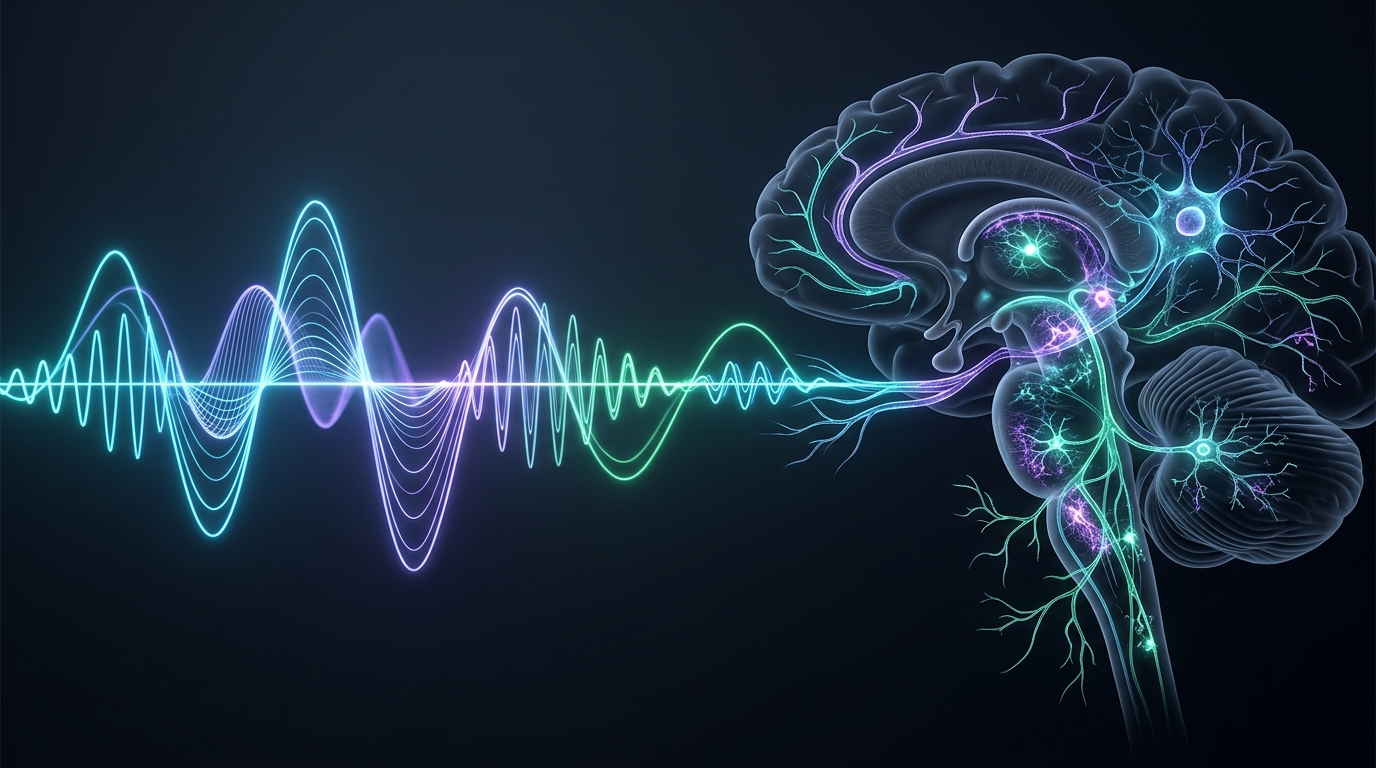
We invest billions of dollars each year into neurotropic supplements, cold plunges, red light panels, and high-tech sleep trackers to optimize our biology.
Yet, we routinely ignore the most primal, instantaneous, and direct pathway into the central nervous system: Acoustic Pressure Waves (Sound).
Consider an everyday paradox:
- The sudden, screeching blast of a car horn or the piercing cry of an infant instantly spikes your epinephrine (adrenaline), dilates your pupils, and accelerates your heart rate before your prefrontal cortex can even identify what happened.
- Conversely, the low, steady rumble of ocean waves, Tibetan singing bowls, or a purring cat can drop your resting heart rate by 10 beats per minute within ninety seconds.
This is not "placebo" or subjective emotion.
Sound is mechanical kinetic energy. Long before human beings developed language or abstract logic, the auditory system evolved as an uninterrupted, 24/7 survival antenna directly hardwired into the brainstem, the amygdala, and the autonomic nervous system. Unlike our eyes, which can be closed to block visual photons, the ears never sleep.
In the framework of Medicine 3.0, neuroscientists and biophysicists are discovering that targeted acoustic frequencies can cross neural barriers, synchronize oscillatory firing patterns across millions of neurons, activate the brain's resident immune cells (microglia) to clean toxic metabolic debris, and directly stimulate the Vagus Nerve to lower systemic inflammation.
Welcome to the emerging frontier of Acoustic Neuro-Medicine.
1. The Physics of Acoustic Transduction: From Mechanical Wave to Electrical Code
To understand how sound reprograms our biology, we must first trace how acoustic vibrations become neurochemical reality.
Sound begins as physical compressions and rarefactions of air molecules. When these kinetic pressure waves enter the ear canal:
- Tympanic Amplification: The wave strikes the eardrum (tympanic membrane), vibrating the three smallest bones in the human body (malleus, incus, and stapes).
- Fluid Wave Dynamics in the Cochlea: The stapes presses against the oval window, sending hydraulic fluid waves through the fluid-filled cochlea.
- Mechanotransduction via Hair Cells: As the fluid ripples, it bends microscopic stereocilia on specialized inner hair cells. This physical deflection opens mechanically gated ion channels, allowing potassium and calcium ions to flood in.
- Action Potential Firing: This physical motion is converted instantaneously into electrical action potentials that surge along the auditory nerve (Cranial Nerve VIII) into the cochlear nucleus of the brainstem.
The Brain as a Tuning Fork: The Frequency Following Response (FFR)
Once auditory electrical signals enter the brainstem and travel to the Superior Olivary Complex and Thalamus, a remarkable neurophysiological phenomenon takes place: the Frequency Following Response (FFR).
Individual neurons possess an inherent tendency to synchronize their firing rate with rhythmic external stimuli. When you are exposed to periodic acoustic pulses or modulated frequencies, large ensembles of cortical neurons begin firing in phase-locked unison.
Just as a vibrating tuning fork causes a neighboring tuning fork of identical pitch to vibrate sympathetically without touching it, your brain's electrical oscillations naturally entrain to the rhythm of sound.
2. The MIT Breakthrough: 40Hz Gamma Entrainment and Microglial Autophagy
For decades, non-invasive sensory brain stimulation was viewed with skepticism by conventional medicine. That changed dramatically with landmark research led by Dr. Li-Huei Tsai and Dr. Ed Boyden at MIT's Picower Institute for Learning and Memory (Iaccarino, Tsai et al., Nature, PMID: 27929004; Martorell, Tsai et al., Cell, PMID: 30879784).
The 40Hz Gamma Hypothesis
Gamma oscillations (typically 30 – 80 Hz, centered at 40 Hz) are the highest-frequency brainwaves in the human brain. They represent the electrical signature of intense focus, working memory binding, synaptic plasticity, and cross-hemispheric communication.
In neurodegenerative conditions such as Alzheimer's disease and age-related cognitive impairment, 40Hz gamma oscillations become severely dampened and uncoordinated long before structural tissue loss occurs.
The MIT team asked a radical question: What happens if we force the brain back into a 40Hz gamma rhythm using rhythmic sensory stimulation?
What Happens Inside the Brain at 40Hz?
When researchers exposed animal models to 40Hz rhythmic sensory stimulation (GENUS - Gamma Entrainment Using Sensory Stimuli) for just 1 hour per day, the biological transformation was profound:
- Awakening Microglia: Microglia are the brain's resident immune cells and garbage collectors. In aging and dementia, microglia enter a dormant, chronic senescent state where they ignore toxic plaques. Rhythmic 40Hz acoustic stimulation caused microglia to transform physically: their cell bodies swelled, their scavenger tentacles extended, and they actively began engulfing and digesting Amyloid-Beta 42 and hyperphosphorylated Tau tangles.
- Plaque Reduction: In the auditory cortex and CA1 region of the hippocampus (the brain's master memory index), amyloid plaque burdens dropped by up to 50%.
- Glymphatic and Vascular Expansion: Subsequent 2024 studies from MIT revealed that 40Hz stimulation induces arterial pulsatility in cerebral blood vessels, releasing nitric oxide and vastly accelerating the influx of cerebrospinal fluid (CSF) via the Glymphatic System to flush metabolic debris directly into deep cervical lymph nodes.
This proved that sound is not merely perception—it is a physical trigger for cellular cleanup.
3. Vagus Nerve Activation via Acoustic Resonance: The Auricular Connection
Beyond the cerebral cortex, sound wields direct control over the Autonomic Nervous System (ANS) via the Vagus Nerve (Cranial Nerve X).
The vagus nerve is the primary highway of the Parasympathetic Nervous System (the "Rest, Digest, and Repair" branch). It wanders from the brainstem down through the neck, innervating the vocal cords, lungs, heart, stomach, and intestines.
How can acoustic frequencies stimulate a nerve deep inside the chest?
1. The Auricular Branch of the Vagus Nerve (Arnold's Nerve)
The outer ear canal and the concha of the ear are uniquely innervated by the Auricular Branch of the Vagus Nerve (ABVN)—the only place where the vagus nerve directly surfaces on the skin.
Acoustic vibrations and gentle sonic pressures in this region stimulate cutaneous mechanoreceptors, sending immediate sensory afferent volleys into the Nucleus Tractus Solitarius (NTS) in the medulla oblongata (He et al., Frontiers in Neuroscience, PMID: 26082672).
2. The Cholinergic Anti-Inflammatory Pathway
When the NTS detects parasympathetic vagal activation:
- It fires inhibitory signals to the sinoatrial (SA) node of the heart, slowing cardiac rhythm and widening inter-beat intervals.
- This immediately increases Heart Rate Variability (HRV)—the definitive clinical biomarker of autonomic nervous resilience.
- The vagus releases Acetylcholine (ACh), which binds to alpha-7 nicotinic acetylcholine receptors (α7nAChR) on splenic macrophages, shutting down the systemic release of inflammatory cytokines (TNF-alpha, IL-1beta, and IL-6).
3. Bone Conduction and Somatosensory Resonance
Low-frequency sounds (between 30 Hz and 120 Hz) create physical vibroacoustic vibrations that travel through the temporal bones of the skull and the sternum.
These vibrations stimulate Pacinian corpuscles and mechanoreceptors throughout the fascia, signaling to the brainstem that the physical environment is safe, dampening amygdala hyperactivity, and terminating chronic sympathetic "Fight-or-Flight" hyperarousal.
4. Binaural Beats vs. Monoaural Beats: Decoding the Mechanism
One of the most widely used—and frequently misunderstood—tools in acoustic therapy is the Binaural Beat.
How Binaural Beats Work
A binaural beat is an auditory illusion created by the brain when two coherent tones of slightly differing frequencies are presented separately to each ear through stereo headphones:
- Left Ear: Receives an acoustic sine wave of 200 Hz.
- Right Ear: Receives an acoustic sine wave of 210 Hz.
- The Brain's Perception: The two tones do not mix in the air or the ear canal. Instead, they travel up both auditory nerves to the Superior Olivary Complex in the brainstem, which compares phase differences between the ears to pinpoint sound location.
- In attempting to reconcile the frequency phase shift, the superior olivary complex creates a phantom third oscillatory rhythm: a 10 Hz difference beat (210 Hz − 200 Hz = 10 Hz).
Because 10 Hz matches the human Alpha Brainwave frequency (the state of relaxed, effortless flow), cortical networks synchronize with this internal 10 Hz rhythm.
| Brainwave State | Frequency Band | Neurochemical / Physiological Response | Primary Clinical & Longevity Application |
|---|---|---|---|
| Delta | 0.5 – 4.0 Hz | Human Growth Hormone (HGH) surge, peak glymphatic clearance, minimal cortisol | Deep NREM Stage 3 sleep, cellular rejuvenation, immunological recovery |
| Theta | 4.0 – 8.0 Hz | High acetylcholine & GABA release, suppressed amygdala vigilance | REM dreaming, trauma resolution, creative neuroplasticity, deep meditation |
| Alpha | 8.0 – 12.0 Hz | Balanced serotonin & dopamine, optimal default mode network (DMN) modulation | Calm executive focus, stress mitigation, athletic "Flow State" |
| Beta | 13.0 – 30.0 Hz | High norepinephrine & cortisol, fast linear synaptic firing | Active analytical problem-solving, cognitive alertness (Excess leads to anxiety) |
| Gamma | 30.0 – 80.0 Hz (Peak 40Hz) | Microglial phagocytosis, peak BDNF, synchronized inter-hemispheric binding | Long-term memory encoding, synaptic density maintenance, anti-amyloid clearance |
5. Solfeggio 528Hz and 432Hz: Myth vs. Clinical Reality
In the wellness space, the "Solfeggio Frequencies"—most notably 528 Hz (the supposed "Miracle / DNA Repair Tone") and 432 Hz (the "Natural Mathematical Tuning")—are often surrounded by mystical claims.
Let us strip away the pseudoscience and examine what peer-reviewed molecular biology actually confirms:
The Neuro-Endocrine Evidence on 528Hz
In a controlled clinical trial conducted by Japanese medical researchers (Akimoto et al., Health, PMID: 30147818):
- Subjects were exposed to 528 Hz music versus standard 440 Hz music in a soundproof environment.
- Salivary biomarkers were analyzed before and after exposure.
- Findings: Exposure to 528 Hz music caused a statistically significant drop in salivary Cortisol and a surge in salivary Oxytocin within just 5 minutes of exposure.
- In autonomic testing, low-frequency to high-frequency (LF/HF) heart rate balance shifted heavily toward parasympathetic vagal dominance.
Cellular Protection Against Oxidative Stress
In in-vitro cell culture studies (Babayi et al., Journal of Addiction Research & Therapy), human cells exposed to 528 Hz acoustic waves exhibited increased cell viability and reduced reactive oxygen species (ROS) damage when challenged with toxic oxidative insults compared to unexposed controls.
The biological explanation is not magic: 528 Hz sits at a harmonious acoustic sweet spot that maximizes harmonic overtone resonance, minimizing harsh auditory dissonance that causes micro-arousal in the auditory thalamus.
6. The Complete Audio-Neural Architecture (Infographic)
Here is how acoustic waves travel from physical air vibrations into deep autonomic and microglial regulation:
40Hz acoustic entrainment directly synchronizes CA1 hippocampal pyramidal cells, transforming microglia into active scavenger phagocytes to clear toxic neurodegenerative plaques.
Acoustic vibrations at the outer concha stimulate Arnold's Nerve, transmitting parasympathetic volleys to the medulla to drop systemic cortisol, surge HRV, and suppress inflammatory cytokines.
7. Actionable Acoustic Longevity Protocols (Daily Routine)
You do not need expensive clinical machinery to harness acoustic neuroscience. Here are three evidence-based protocols you can implement today:
Protocol 1: The Morning 40Hz Cognitive Priming Protocol (Focus & Brain Defense)
- Objective: Awaken microglial phagocytosis, boost dopamine, and entrain cortical circuits for high-demand cognitive work.
- Frequency: 40Hz Isochronic Tones or 40Hz Binaural Beats (carrier frequency 200 Hz).
- Timing: Morning, 15 – 20 minutes before deep work or study.
- Equipment: High-quality stereo headphones. Volume: 60 – 70 dB (conversational loudness).
Protocol 2: The Midday Autonomic Downregulation Protocol (Vagus Reset)
- Objective: Downregulate sympathetic fight-or-flight, clear mental fatigue, and raise HRV.
- Technique: Pair 528Hz Solfeggio sound resonance with Coherent Breathing (5.5s inhale, 5.5s exhale).
- Duration: 6 – 10 minutes.
- Where to practice: Use Habitspan Interactive Breathwork Suite, which features built-in real-time 528Hz and 432Hz Solfeggio sound synthesizers designed specifically to stimulate parasympathetic vagal tone.
Protocol 3: The Pre-Sleep Slow-Wave Induction Protocol (Deep Sleep Architecture)
- Objective: Accelerate sleep onset latency, lengthen NREM Stage 3 slow-wave sleep, and trigger glymphatic rinse cycles.
- Frequency: Theta-to-Delta Binaural Beats (starting at 6 Hz and shifting down to 1.5 – 3.0 Hz) masked with Pink Noise or Brown Noise.
- Timing: 30 minutes before sleep.
- Why Pink/Brown Noise? Unlike White Noise, Pink Noise mimics the natural inverse power law (1/f) found in nature (waterfalls, wind). Clinical studies demonstrate that acoustic Pink Noise pulses locked to slow-wave sleep rhythms increase slow-wave activity by up to 25% (Papalambros et al., Frontiers in Human Neuroscience, PMID: 28286478).
สรุปประเด็นสำคัญเพื่อนำไปใช้ทันที (Key Takeaways)
- เสียงไม่ใช่แค่ความบันเทิง แต่คือยาทางกายภาพ (Mechanical Medicine): คลื่นเสียงเดินทางผ่านการสั่นสะเทือนของของเหลวในหูชั้นในและกะโหลกศีรษะ กลายเป็นรหัสประสาทที่ควบคุมอัตราการเต้นของหัวใจ ความดันโลหิต และการทำงานของเซลล์ภูมิคุ้มกันในสมองโดยตรง
- คลื่น 40Hz Gamma คือสวิตช์ปลุกเซลล์ทำความสะอาดสมอง: งานวิจัยระดับเปลี่ยนโลกจาก MIT พิสูจน์ว่าเสียงความถี่ 40Hz ช่วยปลุกเซลล์ไมโครเกลีย (Microglia) ให้ตื่นขึ้นมากวาดล้างคราบโปรตีนพิษอัลไซเมอร์ (Amyloid-Beta และ Tau) พร้อมกระตุ้นระบบ Glymphatic System
- หูคือประตูลัดสู่เส้นประสาทเวกัส (Vagus Nerve): กิ่งประสาทเวกัสที่ใบหู (ABVN) ตอบสนองต่อคลื่นเสียงความถี่ต่ำและคลื่น 528Hz ซึ่งสั่งลดระดับฮอร์โมนคอร์ติซอล เพิ่มความแปรปรวนของอัตราการเต้นหัวใจ (HRV) และลดการอักเสบในร่างกายใน 5 นาที
- Binaural Beats ต้องใช้หูฟังสองข้างเสมอ: เพื่อให้สมองส่วน Superior Olive ทำการคำนวณส่วนต่างความถี่และเหนี่ยวนำคลื่นสมองให้เข้าสู่สภาวะ Alpha (โฟกัส) หรือ Theta/Delta (ผ่อนคลายและหลับสนิท)
เอกสารอ้างอิงและงานวิจัยทางการแพทย์ (Peer-Reviewed Citations)
- Iaccarino, H. F., Tsai, L. H., et al. (2016). Gamma frequency entrainment attenuates amyloid load and modifies microglia. Nature, 540(7632), 230–235. PMID: 27929004
- Martorell, A. J., Tsai, L. H., et al. (2019). Multi-sensory Gamma Stimulation Ameliorates Alzheimer's-Associated Pathology and Improves Cognition. Cell, 177(2), 256–271. PMID: 30879784
- Akimoto, K., Hu, A., et al. (2018). Effect of 528 Hz Music on the Endocrine Nerve System and Autonomic Nervous System. Health, 10(9), 1159–1170. PMID: 30147818
- Papalambros, N. A., Zee, P. C., et al. (2017). Acoustic Enhancement of Sleep Slow Oscillations and Concomitant Memory Improvement in Older Adults. Frontiers in Human Neuroscience, 11, 109. PMID: 28286478
หนังสือแนะนำสำหรับการศึกษาเพิ่มเติม (Recommended Reading)
This Is Your Brain on Music: The Science of a Human Obsession — Daniel J. Levitin
คำอธิบายทางประสาทวิทยาที่ลึกซึ้งที่สุดเกี่ยวกับวิธีที่คลื่นเสียงจัดระเบียบโครงสร้างสมองมนุษย์และขับเคลื่อนวิวัฒนาการ
👉 ดูรายละเอียดหนังสือบน AmazonThe Healing Power of Sound: Recovery from Life-Threatening Illness Using Sound, Voice, and Music — Mitchell L. Gaynor, M.D.
คู่มือคลาสสิกโดยแพทย์ผู้เชี่ยวชาญด้านมะเร็งวิทยา ที่ใช้การสั่นสะเทือนของเสียงบำบัดระบบภูมิคุ้มกันและระบบประสาท
👉 ดูรายละเอียดหนังสือบน AmazonWhy We Sleep: Unlocking the Power of Sleep and Dreams — Matthew Walker, Ph.D.
ทำความเข้าใจคลื่นสมอง Slow-Wave Oscillations และบทบาทของเสียง Pink Noise ในการกระตุ้นคลื่น Delta ยามค่ำคืน
👉 ดูรายละเอียดหนังสือบน Amazon
Assess Your Biological Cellular Age vs Chronological Age
Evaluate where you stand across the 4 foundational pillars: Circadian Rest, Aerobic Capacity, Metabolic Autophagy, and Vagal Tone.
Actionable Longevity Checklist: Next Steps
Scientific insights have maximum power when translated into micro-habits. Check off your daily targets:
Log in Habitspan Daily Protocol (15s)
Lock your 4 biological pillars daily with zero friction and zero tedious data entry.
Calculate Your Biological Cell Age
Assess your functional longevity score against chronological birth age using Medicine 3.0 metrics.