The 5 AM Club Myth: Genetic Chronotypes, Social Jetlag, and the Perils of Forced Early Waking
Self-help dogma claims waking up at 5:00 AM is the universal master key to discipline and success. Chronobiology tells a starkly different story: your sleep-wake schedule is genetically hardwired. Forcing a night owl into an early morning mold triggers chronic Social Jetlag, amputates REM sleep, and accelerates biological aging.
For the past decade, modern productivity culture has worshipped at the altar of the dawn.
From best-selling self-help manifestos like The 5 AM Club to viral social media routines of Fortune 500 CEOs, the narrative is relentlessly preached: waking up at 5:00 AM is the ultimate test of willpower, discipline, and high performance. If you struggle to leap out of bed before the sun rises, you are subtly labeled as lazy, undisciplined, or lacking ambition.
Seduced by this promise, millions of ambitious individuals force their alarms to sound at 05:00. The initial days feel like an intense exercise in mental grit. But by week three, the harsh biological reality sets in:
- Unrelenting mental fog and executive exhaustion by 14:00.
- Surging cravings for refined carbohydrates and stimulants just to stay awake.
- Heightened irritability, emotional volatility, and blunted creative problem-solving.
- Lying wide awake in bed at 22:30, unable to fall asleep despite feeling physically depleted.
Most people assume this is a personal moral failure—that they simply lack the "grit" to conquer the morning.
In Medicine 3.0 and modern chronobiology, we know this assumption is not only scientifically false, but clinically hazardous. Your ideal sleep-wake timing is not a character trait—it is an innate biological phenotype governed by your genome.
When a natural evening chronotype forces themselves into a 5:00 AM schedule, they do not build superhuman discipline. They subject their central nervous system to chronic Social Jetlag: an insidious state of circadian desynchrony that amputates essential REM sleep, suppresses immune surveillance, and accelerates cellular senescence.
1. The Genetic Blueprint: PER3, CLOCK, and the Evolutionary Sentinel Hypothesis
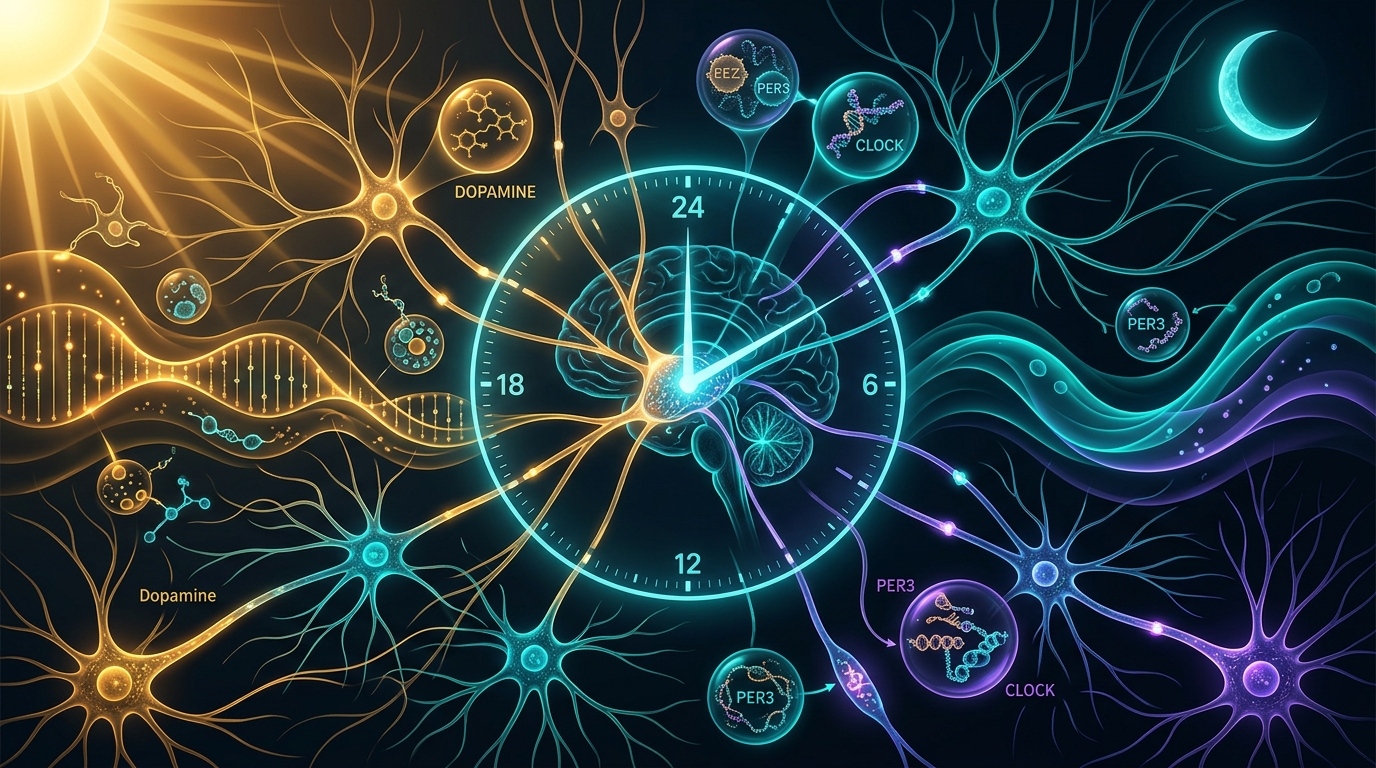
Your internal 24-hour cycle is orchestrated by a master pacemaker in the anterior hypothalamus called the Suprachiasmatic Nucleus (SCN). The SCN is hardwired by a family of autonomous transcription-translation feedback loops governed by core clock genes, most notably PERIOD (PER1, PER2, PER3) and CLOCK.
Circadian Endocrine Shifts: Morning Lark vs. Night Owl
The PER3 Variable Tandem Repeat
Seminal genetic research led by Dr. Simon Archer revealed that variations in the PERIOD3 (PER3) gene directly govern human diurnal preference:
- PER3 5/5 (Long Allele): Individuals homozygous for the long 5-repeat allele exhibit a powerful biological pull toward "morningness" (Morning Larks). They experience rapid homeostatic sleep pressure accumulation throughout the day and wake early with ease.
- PER3 4/4 (Short Allele): Individuals homozygous for the short 4-repeat allele exhibit marked "eveningness" (Night Owls). Their homeostatic sleep pressure accumulates significantly slower, and their endogenous melatonin rhythms peak several hours later in the night.
The Evolutionary Sentinel Hypothesis
Why would evolution create such striking genetic variance instead of a single, unified 5:00 AM wake time?
Chronobiologists and evolutionary anthropologists point to the Sentinel Hypothesis. In ancestral hunter-gatherer bands, having an entire tribe sleep simultaneously for 8 uninterrupted hours would have left the community completely vulnerable to nocturnal predators and hostile rival bands.
By distributing chronotypes across a genetic bell curve:
- The Morning Larks guarded the tribe between 04:00 and 12:00.
- The Intermediate chronotypes functioned from 08:00 to 22:00.
- The Night Owls stood watch and maintained camp fires from 22:00 until 04:00.
Under this distributed biological watch, the vulnerable window where the entire tribe was asleep was reduced from eight hours down to barely two hours. In fact, a landmark 2017 actigraphy study led by Dr. David Samson on the Hadza hunter-gatherers (Proceedings of the Royal Society B) revealed that over 20 days of continuous monitoring, all adult individuals were simultaneously asleep for a total of only 18 minutes. For 99.8% of the nighttime hours, at least one sentinel was awake.
Night owls were literally the evolutionary night watchmen who kept humanity alive. Treating eveningness as a personal character defect contradicts two million years of human evolutionary genetics.
2. The Mechanics of Sleep: Borbély’s Two-Process Model and Social Jetlag
To understand the physiological damage of forcing an unnatural wake-up time, we must examine the Borbély Two-Process Model of Sleep Regulation:
- Process S (Homeostatic Sleep Pressure): As your brain burns adenosine triphosphate (ATP) for cellular energy during waking hours, the breakdown byproduct—adenosine—progressively binds to A1 and A2A adenosine receptors in the basal forebrain and preoptic area. The longer you are awake, the heavier your sleep pressure becomes.
- Process C (Circadian Wakefulness Drive): Controlled strictly by the SCN, Process C acts as an alerting signal that counteracts Process S during the late afternoon and begins dropping sharply in the late evening, permitting sleep onset.
Borbély Two-Process Model of Sleep Regulation
In a synchronized individual, Process S and Process C operate in perfect harmony. Dim Light Melatonin Onset (DLMO) occurs roughly two hours before habitual sleep, core body temperature drops, and sleep onset is effortless.
What is Social Jetlag?
Coined by German chronobiologist Prof. Till Roenneberg, Social Jetlag is the chronic, structural mismatch between your biological circadian clock (determined by your genes and light entrainment) and social time (work hours, school bells, or forced 5:00 AM alarms).
When a natural Night Owl—whose biological sleep window is 00:30 to 08:30—forces themselves to awake at 05:00 AM:
- They attempt to sleep at 21:30, but their endogenous melatonin has not yet surged, and their core body temperature remains elevated. They lie awake tossing and turning.
- When their alarm rings at 05:00 AM, they are torn out of sleep at the absolute coldest nadir of their biological night, when the brain is saturated with melatonin and adenosine.
- It is the physiological equivalent of flying across 3 to 4 time zones every single Monday morning and flying back every Friday night.
3. The 4 Severe Biological Penalties of Forcing Early Waking
Forcing early wakefulness on a night owl does not simply create mild fatigue. It systematically sabotages four core pillars of human longevity:
| Physiological Domain | Natural Chronotype Alignment | Forced 5 AM Wakeup (Night Owl) | Long-Term Healthspan Risk |
|---|---|---|---|
| Sleep Architecture | Complete 4–6 cycles (Full N3 Slow-Wave & REM) | 60% – 80% of REM sleep amputated | Memory fragmentation, loss of emotional resilience |
| Glymphatic Clearance | Optimal AQP4-dependent cerebrospinal fluid flushing | Interrupted clearance cycles; early abort | Accelerated accumulation of amyloid-beta and tau proteins |
| Endocrine & Glucose | Robust morning CAR, normal insulin sensitivity | 30% – 40% reduction in peripheral glucose clearance | Insulin resistance, central obesity, elevated ghrelin |
| Autonomic Tone | Gentle awakening via endogenous cortisol surge | Shock-induced sympathetic adrenergic surge | Elevated resting heart rate, morning endothelial strain |
1. REM Sleep Amputation: The Destroyer of Executive Function
Human sleep cycles last approximately 90 minutes, alternating between Non-Rapid Eye Movement (NREM) and Rapid Eye Movement (REM) sleep. However, their distribution is not equal throughout the night:
- The first third of the night is heavily dominated by N3 Slow-Wave Sleep (Deep Sleep), which repairs skeletal tissue and clears systemic physical fatigue.
- The final third of the night (04:00 – 08:00) is overwhelmingly packed with REM Sleep.
REM sleep is the exclusive neurochemical state where the brain consolidates complex episodic memories, synthesizes creative connections across disparate neural networks, and recalibrates the prefrontal cortex’s emotional brake over the amygdala.
When a night owl cuts their sleep short at 05:00 AM, they are not cutting off equal slices of deep and light sleep. They are amputating up to 70% of their critical REM sleep.
The result? Chronic cognitive blunting, emotional reactivity, executive dysfunction, and impaired decision-making—the exact opposite of the "high performance" promised by the 5 AM Club.
2. Glymphatic Clearance Failure: Neurotoxic Accumulation
In pioneering work published in Science, Dr. Maiken Nedergaard and Dr. Lulu Xie discovered the Glymphatic System: a specialized glia-mediated waste clearance network in the brain.
During restorative deep sleep, glial cells shrink by up to 60%, allowing cerebrospinal fluid (CSF) to rush through interstitial spaces, driven by Aquaporin-4 (AQP4) water channels. This microscopic night-shift washing system literally sweeps toxic metabolic waste products—including amyloid-beta oligomers and hyperphosphorylated tau—out of the central nervous system.
When sleep duration is truncated from the required 8 hours down to 5 or 6 hours by forced early alarm clocks, the glymphatic cycle is prematurely aborted. Over years, this chronic failure of cerebral waste disposal creates the neuroinflammatory bedrock for early-onset cognitive decline and neurodegenerative disease.
3. Metabolic Derangement and Leptin/Ghrelin Dysregulation
Cutting sleep short by forcing early awakenings triggers immediate, profound metabolic chaos:
- Insulin Resistance: Clinical trials have demonstrated that just four consecutive nights of partial sleep restriction (5 hours per night) reduces whole-body insulin sensitivity by 30% to 40%, dragging a healthy adult’s cellular glucose disposal into pre-diabetic ranges.
- Hormonal Hunger Inversion: In the Wisconsin Sleep Cohort Study (n=1,024), Taheri et al. proved that reduced sleep was directly linked to a 15.5% drop in leptin (satiety) and a 14.9% increase in ghrelin (appetite). Furthermore, acute laboratory sleep restriction trials by Spiegel et al. (Annals of Internal Medicine) demonstrated an 18% suppression of leptin coupled with a 28% surge in ghrelin, producing a 24% increase in hunger and severe cravings for calorie-dense, high-carbohydrate foods.
When you force yourself awake at 5:00 AM against your chronotype, your brain experiences acute metabolic distress. By 15:00, the prefrontal cortex loses inhibitory control, and your primitive hypothalamus drives irresistible cravings for high-glycemic carbohydrates and saturated fats.
4. Cardiovascular Shock: Sympathetic Spike During Biological Midnight
In a natural Morning Lark, the cardiovascular system prepares for awakening 60 minutes beforehand: core temperature rises gently, blood pressure climbs, and cortisol increases smoothly via the Cortisol Awakening Response.
When a Night Owl is jolted awake by a 5:00 AM alarm, their body is at its deepest circadian trough: core body temperature is near its minimum (approx. 36.2°C), vascular resistance is low, and melatonin is still actively suppressing cardiovascular vigor.
The blaring alarm induces an acute, unnatural adrenergic shock: a violent surge of norepinephrine and epinephrine that spikes arterial blood pressure, triggers acute vascular endothelial vasoconstriction, and places severe mechanical strain on coronary arteries.
4. The 4 Human Chronotypes: Discovering Your Biological Architecture
Pioneered by clinical psychologist Dr. Michael Breus and grounded in the Horne-Östberg Morningness-Eveningness Questionnaire (MEQ), human chronotypes fall broadly into four distinct categories:
| Archetype (Chronotype) | Population | Biological Sleep Window | Peak Cognitive Focus Window | 5 AM Club Suitability |
|---|---|---|---|---|
| Lion (Morning Lark) | ~15% | 21:30 – 05:30 | 08:00 – 12:00 | Optimal (Genetically Aligned) |
| Bear (Solar Middle) | ~55% | 23:00 – 07:00 | 10:00 – 14:00 | Moderate Social Jetlag Risk |
| Wolf (Night Owl) | ~20% | 00:30 – 08:30 | 16:00 – 22:00 | Hazardous (Severe Sleep Truncation) |
| Dolphin (Fragmented) | ~10% | Variable / Insomnia | 15:00 – 18:00 (Bursts) | Counterproductive (Spikes Anxiety) |
- The Lion (~15% of population): The classic Morning Lark. High early-morning dopamine and cortisol. Wakes naturally around 05:00 – 06:00. Peak cognitive analytical capability occurs between 08:00 and 12:00. These are the rare individuals for whom the "5 AM Club" actually works—because their genome matches the protocol.
- The Bear (~55% of population): The solar-anchored middle. Represents the vast majority of humanity. Wakes naturally with the sunrise (07:00) and winds down around 23:00. Peak deep work window spans 10:00 to 14:00. Forcing Bears to wake at 05:00 causes moderate, cumulative Social Jetlag.
- The Wolf (~20% of population): The classic Night Owl. Low morning cortisol, delayed melatonin clearance. Wakes naturally between 08:00 and 09:00. Their prefrontal cortex does not reach maximum synaptic firing until late afternoon and evening (16:00 – 22:00). Forcing Wolves into the 5 AM Club is an act of neurobiological self-harm.
- The Dolphin (~10% of population): Light, restless sleepers with high autonomic nervous tone and fragmented sleep architecture. Often battle nocturnal insomnia. Their cognitive peaks occur in bursts during the mid-afternoon.
5. The Medicine 3.0 Circadian Synchronization Protocol
True high performance is not about when you wake up—it is about circadian resonance: aligning your daily behaviors with your biological clock. Follow this 5-step clinical protocol to optimize energy, hormonal health, and cognitive output:
Step 1: Calculate Your Midpoint of Sleep on Free Days (MSFsc)
Do not guess your chronotype based on workdays when alarms dictate your schedule. On consecutive vacation or free days without alarm clocks or alcohol:
- Note the time you naturally fall asleep (e.g., 01:00).
- Note the time you naturally awaken (e.g., 09:00).
- Identify the midpoint: In this example, your midpoint is 05:00.
- If your sleep midpoint is before 03:00, you are a true Morning Type.
- If your sleep midpoint is between 03:00 and 05:00, you are an Intermediate Bear.
- If your sleep midpoint is after 05:00, you are an Evening Wolf.
Step 2: Biological Sleep Anchoring (The 8-Hour Rule)
Anchor your sleep duration to a non-negotiable 7.5 to 8.5 hours centered around your chronotype midpoint. If you are a Wolf whose optimal sleep window is 00:30 to 08:30, negotiate flexible work arrangements or schedule meetings starting after 09:30. Stop burning your biological candle at both ends.
Step 3: Targeted Photonic Entrainment
Photons striking intrinsically photosensitive retinal ganglion cells (ipRGCs) are the primary environmental cue (zeitgeber) resetting your SCN:
- Upon Waking (Regardless of Hour): Step outdoors and view 10,000+ lux natural daylight for 10 to 15 minutes. This initiates the cortisol awakening response and starts a 14-hour timer for evening melatonin production.
- The Evening Photonic Sunset: 90 minutes before your chronotype-aligned bedtime, eliminate ceiling halogen lights, turn down overhead LED luminescence, and switch to low-level warm amber illumination (< 2,700K). Blue and green photons (450–480 nm) at night suppress endogenous melatonin by up to 85%.
Step 4: The 90-Minute Adenosine-Caffeine Quarantine
Never consume caffeine immediately upon waking:
- In the first 60 to 90 minutes of wakefulness, your brain is clearing residual adenosine through natural enzymatic activity.
- Flooding your system with caffeine immediately blocks adenosine receptors rather than clearing the molecule. When the caffeine metabolizes 4 to 5 hours later, you experience a devastating "afternoon crash."
- Wait 90 to 120 minutes post-waking before your first cup of coffee or matcha.
- Maintain a strict 10-hour caffeine curfew prior to your planned sleep time.
Step 5: Chronotype-Aligned Deep Work Architecture
Schedule your most demanding cognitive work during your endogenous executive peak:
- Larks & Early Bears: Protect 08:30 – 12:00 for high-stakes analytical, strategic, or writing projects.
- Wolves: Use morning hours (09:30 – 12:00) for administrative, low-friction communications. Protect 16:00 – 20:00 for high-complexity deep work, creative architecture, and complex synthesis.
Key Takeaways for Immediate Action
- Chronotype is Genetic, Not Moral: Diurnal preference is hardwired by the PER3 and CLOCK genes. Forcing yourself to wake up at 5:00 AM does not prove mental toughness; it causes chronic biological desynchrony if it violates your chronotype.
- Social Jetlag Amputates REM Sleep: Waking at 5:00 AM cuts off the second half of the sleep cycle, where up to 70% of REM sleep occurs, causing executive dysfunction, emotional volatility, and brain fog.
- Glymphatic and Metabolic Collapse: Restricting sleep duration to meet arbitrary early morning goals prevents the glymphatic system from flushing neurotoxic amyloid-beta and induces acute insulin resistance comparable to pre-diabetes.
- Shift from 5 AM to Circadian Resonance: True high performance comes from synchronizing sleep duration (7.5–8.5 hours), light exposure, and deep work blocks to your innate biological rhythm.
Clinical Research & Evidence Citations
- Roenneberg, T., et al. (2012). Social jetlag and obesity. Current Biology, 22(10), 939–943. PubMed PMID: 22578422 | DOI: 10.1016/j.cub.2012.03.038
- Wittmann, M., Dinich, J., Merrow, M., & Roenneberg, T. (2006). Social jetlag: misalignment of biological and social time. Chronobiology International, 23(1–2), 497–509. PubMed PMID: 16687322 | DOI: 10.1080/07420520500545979
- Archer, S. N., et al. (2003). A length polymorphism in the circadian clock gene Period3 is linked to delayed sleep phase syndrome and extreme diurnal preference. Sleep, 26(4), 413–415. PubMed PMID: 12841365 | DOI: 10.1093/sleep/26.4.413
- Samson, D. R., et al. (2017). Chronotype variation drives night-time sentinel-like behaviour in hunter-gatherers. Proceedings of the Royal Society B: Biological Sciences, 284(1858), 20170967. PubMed PMID: 28701479 | DOI: 10.1098/rspb.2017.0967
- Xie, L., et al. (2013). Sleep drives metabolite clearance from the adult brain. Science, 342(6156), 373–377. PubMed PMID: 24136965 | DOI: 10.1126/science.1241224
- Taheri, S., et al. (2004). Short sleep duration is associated with reduced leptin, elevated ghrelin, and increased body mass index. PLoS Medicine, 1(3), e62. PubMed PMID: 15602591 | DOI: 10.1371/journal.pmed.0010062
- Spiegel, K., et al. (2004). Brief communication: Sleep curtailment in healthy young men is associated with decreased leptin levels, elevated ghrelin levels, and increased hunger and appetite. Annals of Internal Medicine, 141(11), 846–850. PubMed PMID: 15583226 | DOI: 10.7326/0003-4819-141-11-200412070-00008
Recommended Reading
To master chronobiology, circadian synchronization, and the neurobiology of restorative sleep architecture:
- Matthew Walker, PhD — Why We Sleep: Unlocking the Power of Sleep and Dreams The groundbreaking, international best-selling masterwork detailing how sleep architecture governs cognitive performance, immune integrity, and longevity.
- Till Roenneberg, PhD — Internal Time: Chronotypes, Social Jet Lag, and Why You're So Tired The seminal treatise by the world’s leading chronobiologist exploring how modern society’s disregard for biological clocks drives chronic illness and fatigue.
- Michael Breus, PhD — The Power of When: Discover Your Chronotype--and the Best Time to Eat Lunch, Ask for a Raise, Have Sex, Write a Novel, Take Your Meds, and More A highly practical, clinically validated guide to aligning your daily productivity and lifestyle habits with your innate biological chronotype.
Assess Your Biological Cellular Age vs Chronological Age
Evaluate where you stand across the 4 foundational pillars: Circadian Rest, Aerobic Capacity, Metabolic Autophagy, and Vagal Tone.
Actionable Longevity Checklist: Next Steps
Scientific insights have maximum power when translated into micro-habits. Check off your daily targets:
Log in Habitspan Daily Protocol (15s)
Lock your 4 biological pillars daily with zero friction and zero tedious data entry.
Calculate Your Biological Cell Age
Assess your functional longevity score against chronological birth age using Medicine 3.0 metrics.