Cellular Renewal: The Science of Autophagy, Intermittent Fasting, and Metabolic Longevity
How triggering your body's built-in recycling mechanism clears damaged organelles, improves insulin sensitivity, and extends healthspan.
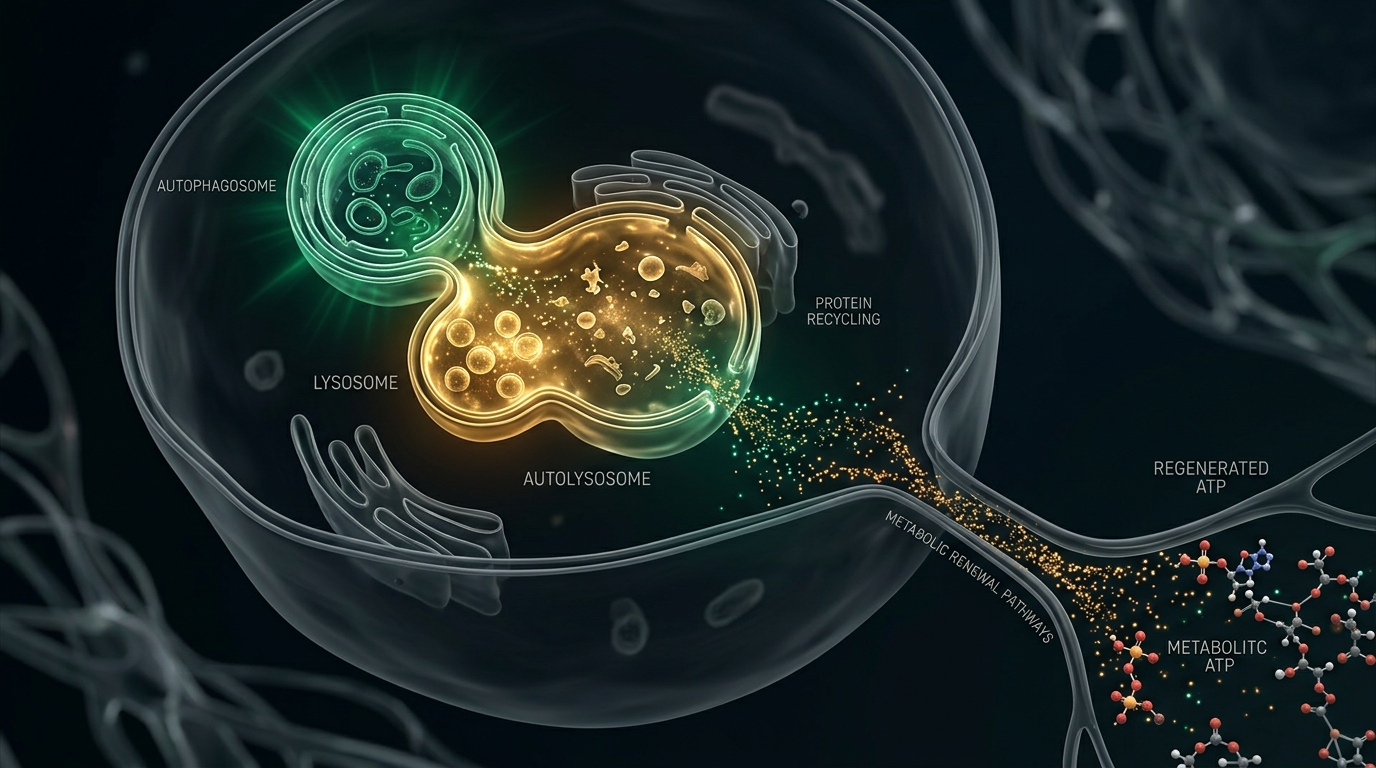
Inside every single one of your thirty trillion cells, a quiet battle against molecular decay is waged every second.
Over time, cellular machinery breaks down. Mitochondria—the power plants of your cells—suffer oxidative damage and leak toxic reactive oxygen species. Structural proteins misfold and clump into dysfunctional aggregates.
If your cells simply allowed this biological debris to accumulate, your tissues would degenerate rapidly. In fact, the buildup of damaged cellular components is one of the primary drivers of accelerated biological aging, neurodegenerative decline, and metabolic dysfunction.
Fortunately, evolution endowed our bodies with an extraordinary self-cleaning process: Autophagy (literally translating from Greek as "self-eating").
Awarded the Nobel Prize in Physiology or Medicine in 2016 to Japanese biologist Yoshinori Ohsumi, autophagy is the cell's innate quality-control system. When activated, cells encapsulate defective organelles and misfolded proteins within double-membrane vesicles called autophagosomes, shuttle them to digestive lysosomes, and break them down into pristine amino acids and fatty acids for energy and cell repair.
Here is the science of how autophagy operates, why chronic eating shuts it down, and the exact protocols to trigger it safely.
1. The Fuel Sensors: mTOR vs. AMPK
Your body governs cellular cleanup through two opposing nutrient-sensing pathways that act like an evolutionary seesaw:
mTOR (Mechanistic Target of Rapamycin) — The Growth Accelerator
mTOR is the body's primary sensor of abundance. When you consume nutrients—particularly carbohydrates (which spike insulin) and animal proteins rich in branched-chain amino acids like leucine—mTOR turns on.
- The Function: mTOR signals cells to grow, synthesize new proteins, and divide.
- The Trade-off: When mTOR is active, autophagy is completely suppressed. A factory cannot clean its machinery while running assembly lines at 100% capacity. Constant grazing keeps mTOR permanently switched on, allowing cellular waste to accumulate unchecked.
AMPK (AMP-activated Protein Kinase) — The Cleanup Coordinator
AMPK is the sensor of energy scarcity. When you fast, exercise, or deplete cellular ATP, the ratio of AMP to ATP rises, activating AMPK.
- The Function: AMPK acts as the master trigger for cellular survival. It directly inhibits mTOR and phosphorylates ULK1, firing the starting gun for autophagy.
- The Result: Starved of external fuel, the cell turns inward, identifying and recycling its oldest, most damaged components to survive.
To maximize healthspan, you do not want to suppress mTOR forever (which causes muscle wasting), nor do you want to keep it elevated constantly. You want metabolic flexibility: oscillating smoothly between nutrient abundance (growth) and nutrient scarcity (cellular repair).
2. The 12-to-16 Hour Fasting Window: Practical Autophagy
You do not need to embark on extreme multi-day starvation to experience the benefits of metabolic clearance. A structured, daily time-restricted eating (TRE) protocol yields profound physiological dividends.
Phase 1: Glycogen Depletion (Hours 0–12)
After your last meal, insulin levels drop, allowing hormone-sensitive lipase (HSL) to liberate fatty acids from adipose tissue. By hour 12, liver glycogen stores are significantly drawn down, and baseline autophagy begins in metabolic tissues.
Phase 2: Autophagy Acceleration (Hours 12–16)
As liver glycogen empties, the body enters mild ketosis, generating beta-hydroxybutyrate (β-HB). AMPK signaling surges, and autophagic flux increases markedly in liver cells, vascular endothelium, and immune monocytes.
The 3-Hour Pre-Bed Rule
The most critical part of this fasting window is stopping all caloric intake at least 3 hours before sleep:
- Eating close to bedtime spikes insulin and blood glucose right when growth hormone and melatonin should be rising.
- Digestion diverts blood flow away from the brain, impairing the glymphatic system (the brain's nightly waste disposal network).
- Finishing dinner by 7:00 PM and breaking fast at 9:00 AM or 11:00 AM creates a natural, effortless 14-to-16 hour cellular renewal window.
3. Beyond Fasting: Synergistic Autophagy Triggers
Fasting is not the only lever you can pull to stimulate cellular clearance. You can compound autophagic flux by stacking biological stressors:
- Zone 2 Aerobic Exercise: Sustained low-intensity cardio depletes glycogen while demanding massive ATP turnover in skeletal muscle, robustly stimulating mitophagy (the selective recycling of dysfunctional mitochondria).
- Thermal Stress (Sauna & Cold): Heat shock proteins (HSPs) induced by 20 minutes in a 80°C (175°F) sauna prevent protein aggregation and assist lysosomes in tagging damaged peptides.
- Polyphenols & Clean Hydration: Black coffee, green tea (EGCG), and resveratrol stimulate AMPK signaling pathways without breaking a physiological fast.
The Cellular Renewal Daily Protocol
Implement these three daily actions to keep your cellular recycling machinery sharp:
- 14-Hour Clean Fast: Finish dinner by 7:30 PM and consume only water, black coffee, or unsweetened tea until 9:30 AM tomorrow.
- Zero Late-Night Snacking: Keep the 3-hour buffer between your last bite of food and your head hitting the pillow.
- Hydrate with Electrolytes: Support cellular detoxification during your morning fasting window with 500ml of filtered water and a pinch of unrefined sea salt.
Peer-Reviewed Scientific Citations & Landmark Evidence
Autophagy in Human Health and Disease (Nobel Prize Science):
Mizushima N, Levine B, Cuervo AM, Klionsky DJ. "Autophagy fights disease through cellular self-digestion." Nature, 2008 Feb 28;451(7182):1069-75.
🔗 PubMed PMID: 18305538 | DOI: 10.1038/nature06639Effects of Intermittent Fasting on Aging, Autophagy, and Disease:
de Cabo R, Mattson MP. "Effects of Intermittent Fasting on Health, Aging, and Disease." New England Journal of Medicine (NEJM), 2019 Dec 26;381(26):2541-2551.
🔗 PubMed PMID: 31881139 | DOI: 10.1056/NEJMra1905136Biological Functions of Autophagy in Longevity:
Levine B, Kroemer G. "Biological Functions of Autophagy Genes: A Disease Perspective." Cell, 2019 Jan 10;176(1-2):11-42.
🔗 PubMed PMID: 30633901 | DOI: 10.1016/j.cell.2018.09.048Exercise-Induced Autophagy & Mitophagy in Muscle Tissue:
He C, Bassik MC, Moresi V, Levine B, et al. "Exercise-induced BCL2-regulated autophagy is required for muscle glucose homeostasis." Nature, 2012 Jan 18;481(7382):511-5.
🔗 PubMed PMID: 22258505 | DOI: 10.1038/nature10758
Recommended Reading
- Outlive: The Science and Art of Longevity by Peter Attia – The definitive modern medical treatise on metabolic health, insulin resistance, and preventing the chronic diseases that shorten human healthspan.
- The Obesity Code by Dr. Jason Fung – A groundbreaking exploration of how intermittent fasting resets insulin sensitivity, unleashes autophagy, and normalizes human body weight.
- The Almanack of Naval Ravikant by Eric Jorgenson – Foundational insights on applying compound interest to personal health, mastering impulse control, and cultivating long-term physiological freedom.
References
- Ohsumi, Y. (2016). Autophagy: An intracellular recycling system — Nobel Lecture. The Nobel Prize in Physiology or Medicine. https://www.nobelprize.org/prizes/medicine/2016/ohsumi/lecture/
- Mizushima, N., Levine, B., Cuervo, A. M., & Klionsky, D. J. (2008). Autophagy fights disease through cellular self-digestion. Nature, 451(7182), 1069–1075. https://doi.org/10.1038/nature06639
- Levine, B., & Kroemer, G. (2008). Autophagy in the pathogenesis of disease. Cell, 132(1), 27–42. https://doi.org/10.1016/j.cell.2007.12.018
- Mattson, M. P., Longo, V. D., & Harvie, M. (2017). Impact of intermittent fasting on health and disease processes. Ageing Research Reviews, 39, 46–58. https://doi.org/10.1016/j.arr.2016.10.005
- Kim, J., Kundu, M., Viollet, B., & Guan, K. L. (2011). AMPK and mTOR regulate autophagy through direct phosphorylation of Ulk1. Nature Cell Biology, 13(2), 132–141. https://doi.org/10.1038/ncb2152
Actionable Longevity Checklist: Next Steps
Scientific insights have maximum power when translated into micro-habits. Check off your daily targets:
Log in Habitspan Daily Protocol (15s)
Lock your 4 biological pillars daily with zero friction and zero tedious data entry.
Calculate Your Biological Cell Age
Assess your functional longevity score against chronological birth age using Medicine 3.0 metrics.