The Biology of Energy Management: Managing Oscillations, Ultradian Rhythms, and Chronic Burnout
Time is finite, but energy can be systematically renewed and expanded. Discover how elite performers align their work with 90-minute ultradian biological rhythms to achieve sustained excellence without burnout.
For over a century, corporate culture has worshipped at the altar of Time Management.
We purchase elaborate planners, download calendar applications, and attempt to squeeze sixteen hours of continuous, linear cognitive labor out of every twenty-four-hour day. We treat our minds and bodies like mechanical computers: capable of operating at maximum speed for twelve consecutive hours, pausing only for a brief fuel injection of caffeine and refined sugar.
The biological reality is merciless: Human beings are not computers. We are complex oscillatory biological organisms.
Every cell, organ, and hormonal cascade in the human body is governed by rhythms of stress and recovery. When you attempt to force continuous linear output without honoring your underlying biological cycles, you do not gain time—you merely deplete the quality, depth, and creative horsepower of your energy.
In the groundbreaking work of Dr. Jim Loehr and Tony Schwartz at the Human Performance Institute, one foundational law emerges:
"Manage your energy, not your time. The number of hours in a day is fixed, but the quantity and quality of energy available to you is elastic and can be systematically expanded."
1. The Basic Rest-Activity Cycle (BRAC) and Ultradian Rhythms
Most people are familiar with Circadian Rhythms—the approximately 24-hour cycle that governs core body temperature, melatonin secretion, and the sleep-wake continuum.
Far fewer understand Ultradian Rhythms: shorter biological oscillations that occur continuously throughout both our waking and sleeping hours.
In the 1950s, pioneering sleep researcher Dr. Nathaniel Kleitman discovered that our nighttime sleep cycles through 90-minute periods of non-REM and REM sleep. Crucially, Kleitman later proved that this exact same biological rhythm operates throughout our waking day—a phenomenon known as the Basic Rest-Activity Cycle (BRAC).
The Dynamics of the 90-Minute Ultradian Wave
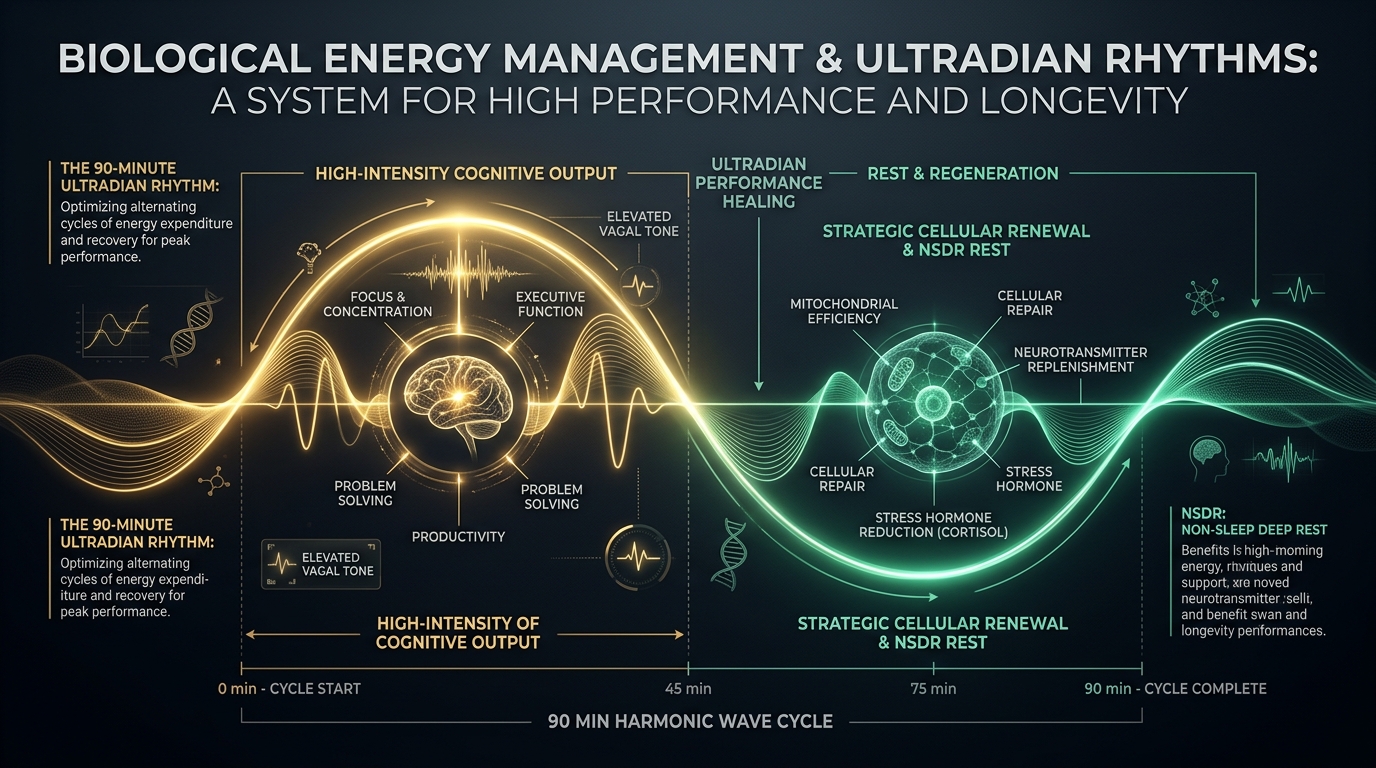
Throughout your waking day, your brain and nervous system operate in repeating 90- to 120-minute waves:
- The Ascent (Minutes 0–20): Focus gathers, dopamine and norepinephrine levels rise, and cognitive friction diminishes.
- The Crest (Minutes 20–80): High-amplitude beta brainwaves predominate. Working memory operates at peak capacity, problem-solving is rapid, and you enter the pocket of peak productivity.
- The Trough (Minutes 80–110): The brain exhausts its immediate intracellular ATP and neurotransmitter reserves. Adenosine levels rise, sympathetic tone shifts toward parasympathetic recovery, and beta waves give way to slower alpha and theta rhythms.
The Great Tragedy of Artificial Overdrive
When the ultradian trough arrives, your body sends clear physiological distress signals: yawning, eye strain, sudden restlessness, loss of concentration, and the urge to snack.
In the modern workplace, instead of honoring this 15-minute biological need for recovery, we reach for an espresso, gulp down an energy drink, and force our nervous system into an artificial sympathetic fight-or-flight overdrive.
By running on borrowed adrenaline and cortisol, you burn out your hypothalamic-pituitary-adrenal (HPA) axis, accumulate toxic cellular fatigue, and enter a state of chronic, low-grade executive exhaustion.
2. The 4 Dimensions of Human Energy Capacity
To build an unbreakable high-performance engine, you must systematically manage energy across all four interconnected biological and psychological dimensions:
| Dimension | Description | |
|---|---|---|
| 1 | Physical | The Foundation (Quantity of Energy): Sleep, hydration, low-glycemic nutrition, and Zone 2 aerobic mitochondria. |
| 2 | Emotional | The Fuel (Quality of Energy): Psychological safety, gratitude, and freedom from chronic threat-detection and cynicism. |
| 3 | Mental | The Focus (Direction of Energy): Deep work blocks, attention residue elimination, and radical cognitive presence. |
| 4 | Spiritual | The Purpose (Force of Energy): Deep alignment with core values, serving a mission transcending self-interest. |
If your physical energy is bankrupt due to chronic sleep deprivation, no amount of positive mindset or goal-setting will prevent cognitive collapse. Energy must be built from the physical bedrock upward.
3. The Elite Performance Protocol: 90-Minute Sprint & 15-Minute Recovery
Top-tier classical musicians, Olympic sprinters, and world-class software architects share a common training signature: They train in focused bursts of 60 to 90 minutes, followed by deliberate, restorative disconnection.
What Constitutes "True Biological Recovery"?
Checking your social media feed, reading stressful news headlines, or answering passive-aggressive emails while eating lunch at your desk is not recovery. It places an active cognitive load on your working memory and keeps sympathetic arousal pinned at maximum.
True biological renewal protocols include:
- Non-Sleep Deep Rest (NSDR) or Yoga Nidra: A 10- to 20-minute guided relaxation session that resets dopamine baselines and downregulates the sympathetic nervous system (Huberman Lab).
- The Panoramic Vision Walk: Stepping outdoors for 10 minutes and consciously relaxing your eyes to take in wide, peripheral horizons. Panoramic vision mechanically halts the amygdala's threat-detection circuitry.
- Physiological Sighs: Executing two deep inhalations through the nose followed by a long, unforced exhalation through the mouth for 3 to 5 rounds instantly triggers vagal tone and lowers heart rate.
- Brisk Hydration & Electrolytes: Drinking 500 mL of cold, electrolyte-rich mineral water to rapidly restore cellular osmolarity.
4. The 3 Tactical Rules for Sustainable Energy Architecture
Rule 1: Eliminate the "Hero to Zero" Linear Fallacy
Stop viewing an 8-hour workday as an unbroken marathon. Structure your calendar into three distinct 90-minute High-Value Sprints, separated by mandatory 15- to 20-minute physical-emotional reset buffers. You will produce significantly more creative breakthrough output in four and a half hours of true high-frequency focus than in ten hours of zombie-like multitasking.
Rule 2: Protect the Early Morning Glycemic Horizon
Spiking your blood sugar with pastries, sweetened coffees, or refined starches at 08:00 induces a sharp postprandial insulin spike that crashes blood glucose by 10:30, coinciding precisely with your natural ultradian dip. Consume a protein- and fat-dense breakfast (pasture-raised eggs, avocado, spinach) or extend your fasting window to preserve pristine, stable ketone-fueled mental clarity.
Rule 3: Enforce Sacred Evening Deceleration
Energy renewal culminates in the nocturnal hours. Two hours before sleep, terminate all cognitively taxing professional correspondence. Dim overhead lighting to allow the pineal gland to release endogenous melatonin, ensuring you enter the deep slow-wave sleep stages where physical cellular repair and glymphatic waste clearance occur.
Clinical & Physiological Citations
- Loehr, J., & Schwartz, T. (2003). The Power of Full Engagement: Managing Energy, Not Time, Is the Key to High Performance and Personal Renewal. Free Press.
- Kleitman, N. (1982). Basic rest-activity cycle—22 years later. Sleep, 5(4), 311–317. PubMed PMID: 7163773
- Schwartz, T., & McCarthy, C. (2007). Manage Your Energy, Not Your Time. Harvard Business Review, 85(10), 63–73.
- Balban, M. Y., et al. (2023). Brief structured respiration practices enhance mood and reduce physiological arousal. Cell Reports Medicine, 4(1), 100895. PubMed PMID: 36630873 | DOI: 10.1016/j.xcrm.2022.100895
Recommended Reading
To master your biological oscillations, prevent professional burnout, and engineer sustained high-output vitality:
- Jim Loehr & Tony Schwartz — The Power of Full Engagement: Managing Energy, Not Time, Is the Key to High Performance and Personal Renewal The groundbreaking treatise on balancing intense energy expenditure with strategic recovery across physical, emotional, mental, and spiritual planes.
- Cal Newport — Deep Work: Rules for Focused Success in a Distracted World The ultimate manual for translating high mental energy into elite, unreplicable cognitive assets.
- James Clear — Atomic Habits: An Easy & Proven Way to Build Good Habits & Break Bad Ones A masterclass on structuring automatic micro-habits for morning energy hydration, movement triggers, and evening deceleration.
Actionable Longevity Checklist: Next Steps
Scientific insights have maximum power when translated into micro-habits. Check off your daily targets:
Log in Habitspan Daily Protocol (15s)
Lock your 4 biological pillars daily with zero friction and zero tedious data entry.
Calculate Your Biological Cell Age
Assess your functional longevity score against chronological birth age using Medicine 3.0 metrics.